
Facebook Twitter Instagram YouTube LinkedIn

Standards-Based Learning

office-001

In the Columbus Diocese, we have made a deliberate, and conscious committment to incorporate standards-based teaching and learning practices in our classrooms. These practices support our essential obligation to provide our students with more than just a rigorous academic curriculum to prepare them for high school, college and beyond. Catholic education must also prepare students to take their place in society as Disciples of Christ; instilling in them a sense of service and challenging them to live the Gospel through daily interactions with all whom they come in contact. Therefore, our focus should be placed on both the student’s moral and intellectual excellence.

There are several advantages of standards-based education:

  • It ensures consistent expectations across grade levels.
  • It helps teachers and students focus on the standards in their learning activities.
  • Assessments are aligned to standards and provide evidence of what a student knows and/or can do.
  • It provides feedback as to a student’s proficiency level allowing the teacher to better individualize instruction.
  • It provides parents with valuable information on how their child is progressing on the critical concepts and skills of the grade level as well as individual standards.

"In standards-based districts and schools, commonly expected, research-based instructional methods and strategies are used to deliver the standards-aligned curriculum and ensure students have adequate and equitable opportunities to learn. . . Consequently, a strong emphasis on ensuring effective classroom instruction is delivered in every classroom, every day is critical to deliver a high-quality, engaging standards-based education to every child." (Colorado Coalition of Standards-Based Education, 2012 pg. 22)
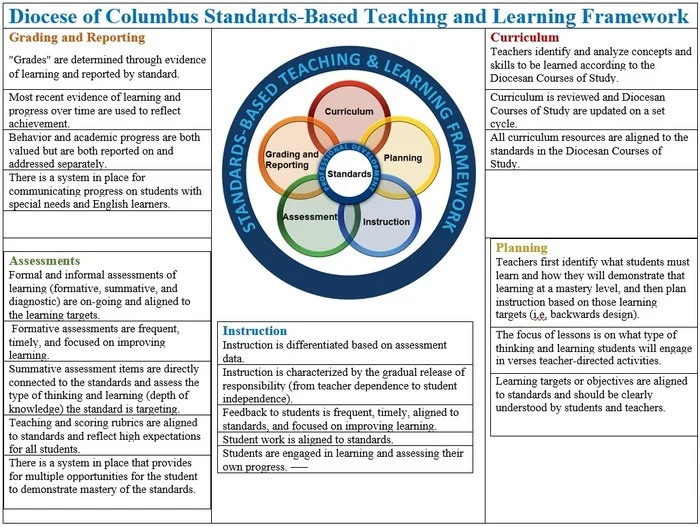
Diocese of Columbus Standards-Based Teaching adn Learning Framework

What are the components needed for a standards-based classroom, including what does it look like/feel like/sound like when it is meeting the needs of students?

Curriculum

  • Teachers identify and analyze concepts and skills to be learned according to the Diocesan Courses of Study.

Planning

  • Teachers first identify what students must learn and be able to do. They must know how the students will demonstrate that learning at a mastery level, and then plan instruction based on those performance objectives and learning targets (i.e, backwards design).
  • The focus of lessons is on what type of thinking and learning students will engage in verses teacher-directed activities.
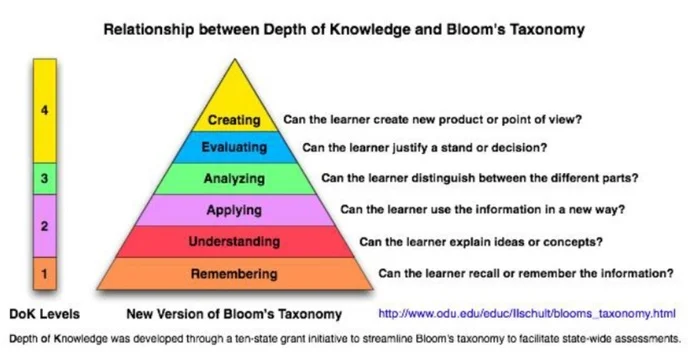
Although these levels are not sequential, educators use this information to design better instruction, based around student thinking and learning. In addition, all students, including the youngest, should have an opportunity to participate in activities or assignments at each of the levels.
  • Learning targets and performance objectives are aligned to standards and should be clearly understood by students and teachers. 
  • Instruction is differentiated based on assessment data.
  • Instruction is characterized by the gradual release of responsibility (from teacher dependence to student independence).
  • Students are engaged in learning and assessing their own progress. Student work is aligned to standards.
  • Feedback to students is frequent, timely, aligned to standards, and focused on improving learning.
DOK and Blooms

The DoK levels are as follows:
DOK 1: Recall and Reproduction
DOK 2: Skills and Concepts
DOK 3: Strategic Thinking
DOK 4: Extended Thinking

Assessments

  • Formal and informal assessments of learning (formative, summative, and diagnostic) are on-going and aligned to the performance objectives and learning targets. The chart below breaks down the different types of assessments and their purposes:

Assessment Type

Purpose

Diagnostic

Assessment that takes place prior to instruction; designed to determine a student’s attitude, skills or knowledge in order to identify student needs (e.g. pretest).

Formative:

Assessment FOR Learning

Assessment designed to provide direction for improvement and/or adjustment to a program for individual students or for a whole class (e.g. observation, quizzes, homework, instructional questions, and initial drafts/attempts).

Summative:

Assessment OF Learning

Assessment designed to provide information to be used in making judgements about a student’s achievement at the end of a sequence of instruction (e.g. tests, exams, portfolios, assignments, projects, performances, and final drafts/attempts)

  • Formative assessments are frequent, timely, and focused on improving learning.
  • Summative assessment items are directly connected to the standards and assess the type of thinking and learning (depth of knowledge) the standard is targeting.
  • Teaching and scoring rubrics are aligned to standards and reflect high expectations for all students.
  • There is a system in place that provides for multiple opportunities for the student to demonstrate mastery of the standards.

Grading and Reporting

  • "Grades" are determined through evidence of learning and reported by standard.
  • Most recent evidence and progress over time are used to reflect achievement.
  • Behavior and academic progress are both valued but are reported on and addressed differently.
  • There is a system in place for communicating progress on students with special needs and English learners.

Find a School Near You